
All prints are made-to-order and will require one to two weeks’ production time before being shipped. Each order will be acknowledged after payment has been received to confirm the shipping date. To customers who order prints of the same image subsequent to their original order, there may be slight variations in image density and/or contrast when compared to the initial print. If exact matching prints are desired, these should be ordered at the same time.
All prints are shipped flat, durably mounted on high quality backing board with two inch borders top and sides and a five inch border at bottom.
Custom Matting and Framing crafted to fit the Mount Board Size shown will be required to complete the presentation. The bottom border will show below the lower right corner of the image the photographer’s signature. Due to slight size variations please await receipt of your mounted print before ordering custom matting and framing.
Reproduction or publishing of prints sold on this website and related websites in whole or in part in any form, photographically, digitally, or otherwise, is strictly prohibited. The purchase of a print on this website is intended for buyer’s exclusive use in a single display location, and buyer accepts these conditions without modification. Please see Terms and Conditions of Sale for further clarification and additional terms and conditions for the sale of prints.
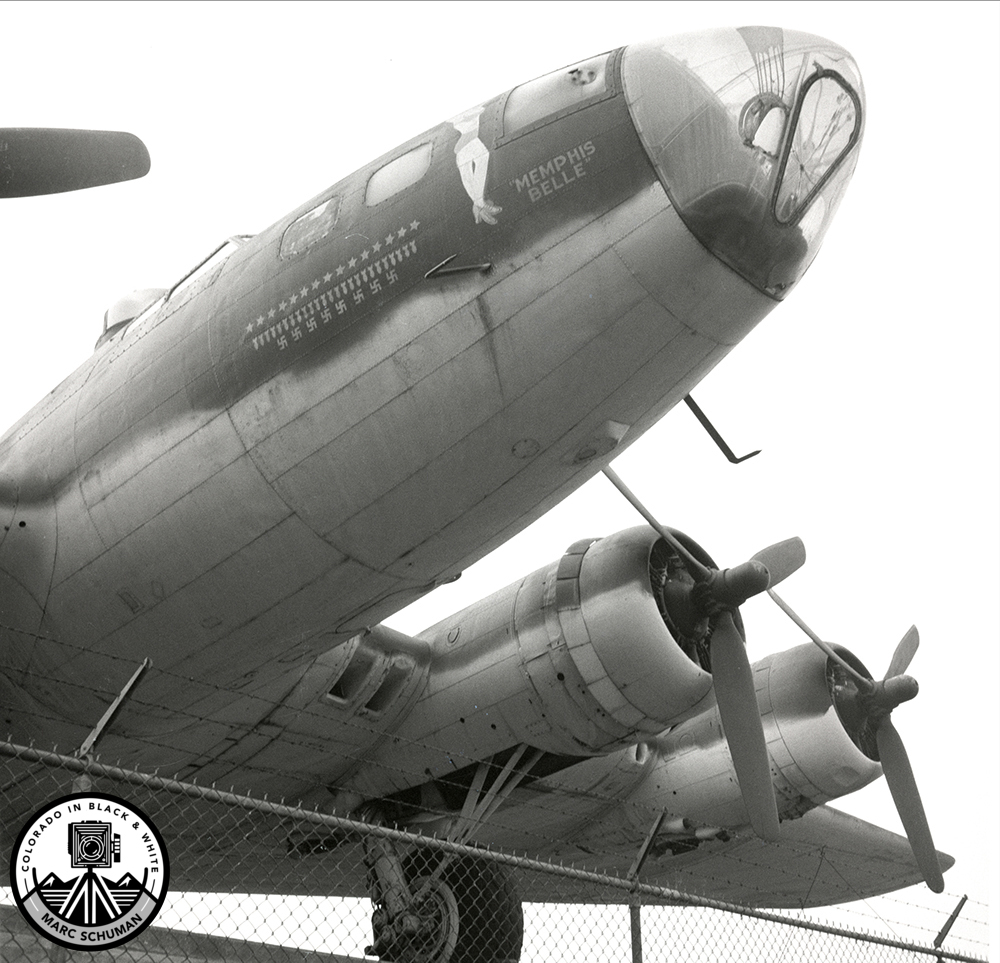
“Memphis Belle” Boeing B-17F, Memphis, Tennessee, August, 1964.
For almost thirty years, the storied “Memphis Belle” B-17F resided on a concrete pedestal on the grounds of the Tennessee National Guard Armory in Memphis, before being moved near the Memphis airport. This airplane was the first Eighth Air Force bomber to complete twenty-five missions. It then flew back to the United States to help sell war bonds, never returning to Europe and instead used for training pilots. In 1950, the plane was placed on the concrete pedestal as seen here, gradually deteriorating from the weather and vandalism. Evidence of vandalism is visible in the bombardier’s windscreen and on the nose canopy. After years of further display near the Memphis
airport, the aircraft was in 2005 shipped to the National Museum of the Air Force in Dayton, Ohio, where it was restored over a twelve-year period and finally put on permanent display. This is likely the most famous B-17 of the thousands produced during WWII. However, the “F” model lacked the chin turret of the “G” model and was vulnerable to frontal fighter attack. This photograph was made with a Kodak Instamatic 500 which employed a 38mm f2.8 Schneider Xenar lens. Kodak 126 Verichrome Pan black and white film was used.
#memphisbelle
#b17f
The watermark is a security device and will not appear in your print.