
All prints are made-to-order and will require one to two weeks’ production time before being shipped. Each order will be acknowledged after payment has been received to confirm the shipping date. To customers who order prints of the same image subsequent to their original order, there may be slight variations in image density and/or contrast when compared to the initial print. If exact matching prints are desired, these should be ordered at the same time.
All prints are shipped flat, durably mounted on high quality backing board with two inch borders top and sides and a five inch border at bottom.
Custom Matting and Framing crafted to fit the Mount Board Size shown will be required to complete the presentation. The bottom border will show below the lower right corner of the image the photographer’s signature. Due to slight size variations please await receipt of your mounted print before ordering custom matting and framing from your local vendor.
Reproduction or publishing of prints sold on this website and related websites in whole or in part in any form, photographically, digitally, or otherwise, is strictly prohibited. The purchase of a print on this website is intended for buyer’s exclusive use in a single display location, and buyer accepts these conditions without modification. Please see Terms and Conditions of Sale for further clarification and additional terms and conditions for the sale of prints.
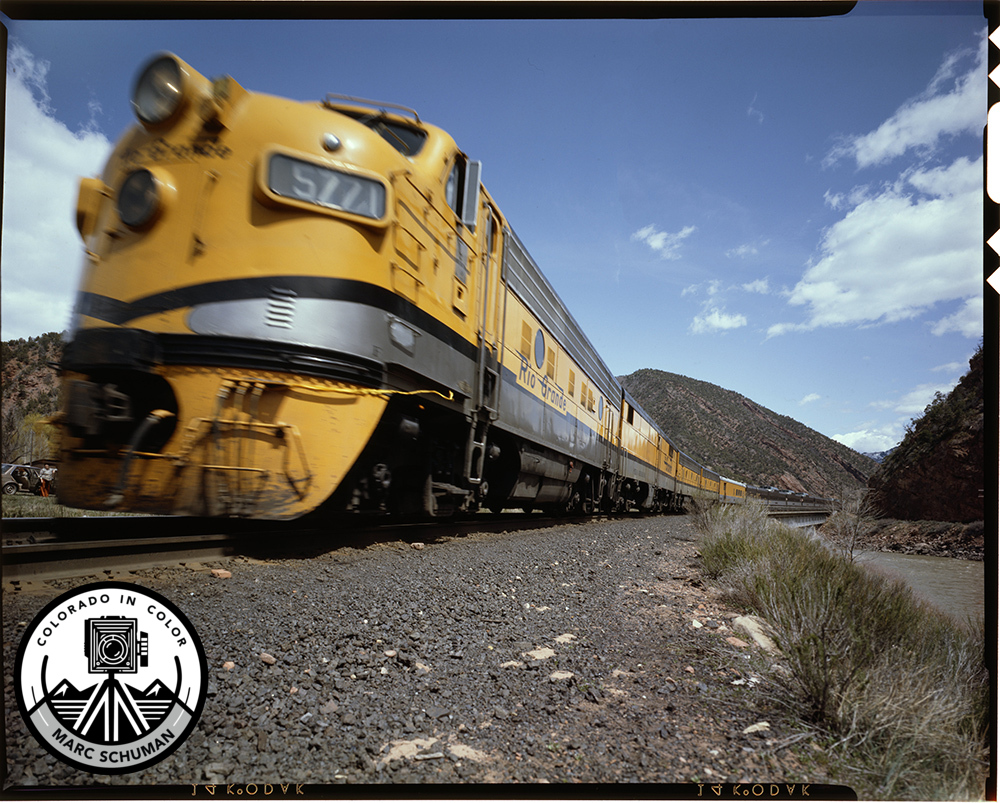
Rio Grande Zephyr West Bound, South Canyon West of Glenwood Springs, Colorado, April 1983.
The slight noticeable curvature of the livery straight line on the side of Engine #5771 is the dead give-away that my Speed Graphic’s focal plane shutter, rather than the 90 mm f8.0 Schneider Super Angulon’s leaf shutter, was used to make this unusual image of the west bound Zephyr at the Chacra Bridge in South Canyon, west of Glenwood Springs. Standing less than eight feet from the track on which this train was traveling 50 miles per hour implied that the engine’s front moved about two feet during the time of the 1/1000 sec exposure. At a distance this close to the track the relative angular motion of the train was such that completely stopping the engine’s motion was almost impossible with my vintage press camera. A focal plane shutter exposure slit must vertically travel four inches across the film plane, regardless of the shutter speed used. Though each section of the film was only exposed for 1/1000 second, the engine had moved two feet during the shutter exposure slit’s travel, causing the same kind of elongated image distortion that rendered the wheels of racing cars into oval shapes when photographed with cameras using focal plane shutters in the early twentieth century. An interesting anecdote for those willing to take the time to read and understand this post. This image demonstrated the power and speed of the Zephyr in a way that no other image I took of this storied train conveys. A spectator stood in the distance just beyond the front of the train, indicating the great interest in the Zephyr in its final days.
#engine5771
#riograndezephyr
The logo is a security device and will not appear in your print.