
All prints are made-to-order and will require one to two weeks’ production time before being shipped. Each order will be acknowledged after payment has been received to confirm the shipping date. To customers who order prints of the same image subsequent to their original order, there may be slight variations in image density and/or contrast when compared to the initial print. If exact matching prints are desired, these should be ordered at the same time.
All prints are shipped flat, durably mounted on high quality backing board with two inch borders top and sides and a five inch border at bottom.
Custom Matting and Framing crafted to fit the Mount Board Size shown will be required to complete the presentation. The bottom border will show below the lower right corner of the image the photographer’s signature. Due to slight size variations please await receipt of your mounted print before ordering custom matting and framing from your local vendor.
Reproduction or publishing of prints sold on this website and related websites in whole or in part in any form, photographically, digitally, or otherwise, is strictly prohibited. The purchase of a print on this website is intended for buyer’s exclusive use in a single display location, and buyer accepts these conditions without modification. Please see Terms and Conditions of Sale for further clarification and additional terms and conditions for the sale of prints.
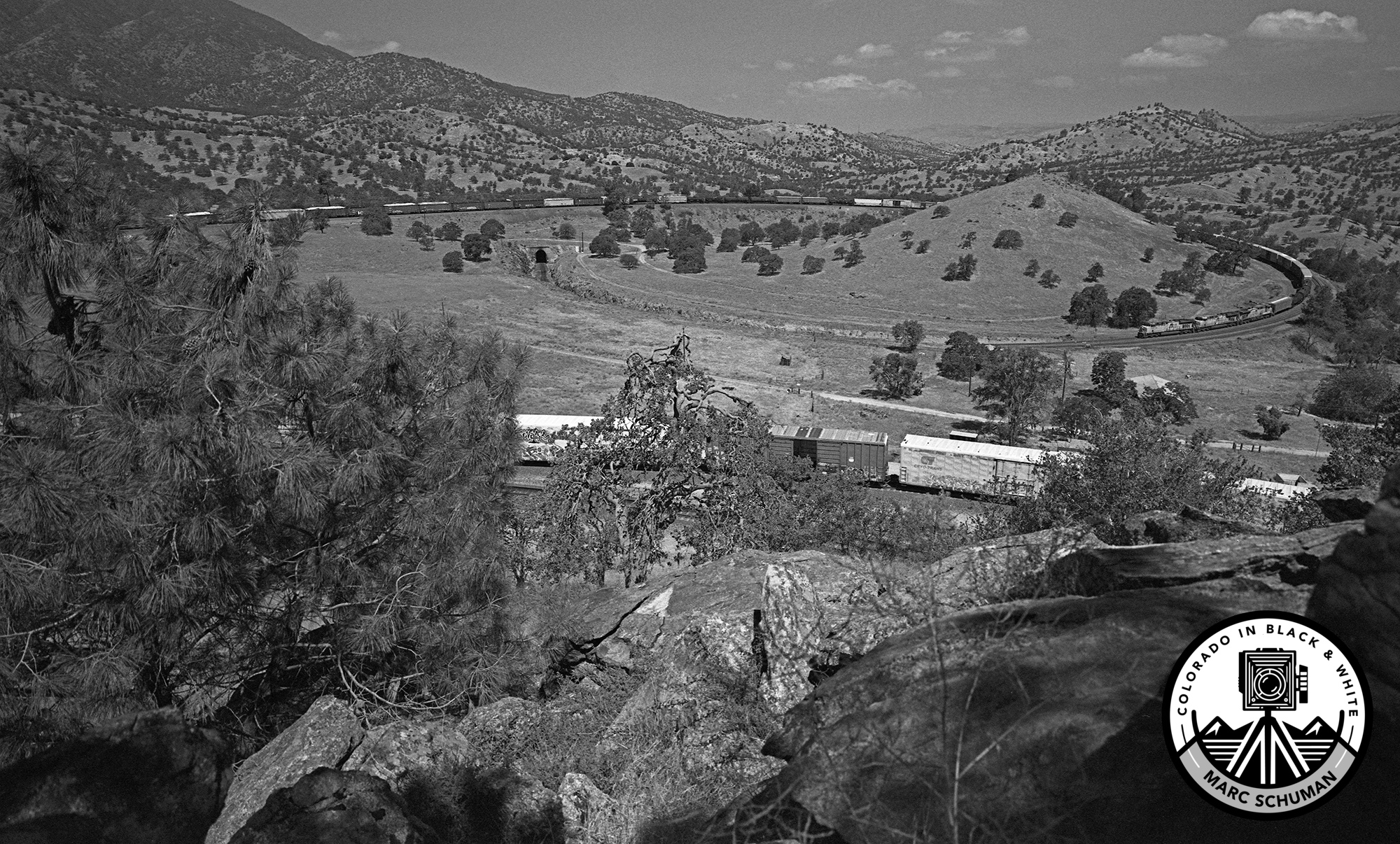
Tehachapi Loop, Kern County, California, May 30 2026 (Black and White Image)
Three Union Pacific locomotives at frame right make their way westbound after summiting Tehatchapi Loop. The train is moving right to left towards the single-track tunnel underneath the freight cars to the left of center. Cars in the foreground, part of the same train, have yet to summit the loop. No other present-day scene in American railroading rivals Tehachapi Loop. In just two years beginning in 1874, two civil engineers designed and 3000 Cantonese Chinese laborers built a network of tunnels and bridges over Tehachapi Pass including the famed loop seen here. 30 to 40 trains per day transporting mostly intermodal container freight and bulk goods pass this way–empty westbound containers returning to the Port of Long Beach to be loaded on ships returning to China and eastbound intermodal containers loaded with goods destined for consumers all over the US. To witness rail traffic at this place for just a few hours is to understand the immensity of trade between the US and the Far East, China specifically. Along with similar container traffic on mostly double-track from the Port of Oakland in northern California through Utah, Wyoming, Nebraska and points east, it is clear that the railroads play a vital role in moving goods throughout the enormous US consumer market. Taken with a Fuji G690 medium format camera employing a Fujinon 50mm f5.6 wide angle lens on Kodak black and white film.
The logo is a security watermark and will not appear in your print.