
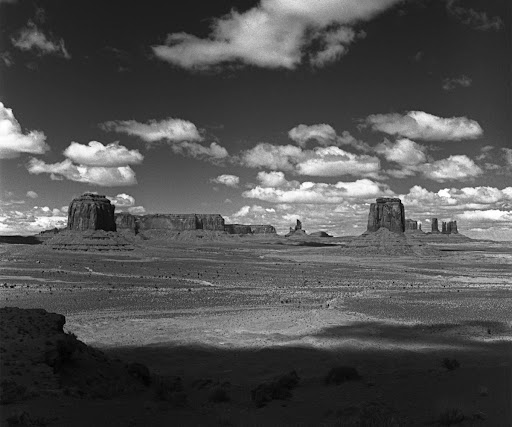
A black-and-white photograph can be the same image and still become a very different object on the wall. In the question of darkroom print vs inkjet, the meaningful distinction is not simply old process versus new technology. It is a question of material, interpretation, surface, scale, and the character a print carries in a room.
For collectors, designers, and anyone choosing a photograph to live with over time, both methods can produce beautiful work. They do not, however, produce the same kind of beauty.
Darkroom Print vs Inkjet: Two Ways of Interpreting a Negative
A traditional darkroom print begins with a film negative. Light passes through that negative onto photographic paper coated with light-sensitive silver halide emulsion. The print is developed, stopped, fixed, washed, and carefully dried. With a fiber-base silver gelatin print, the paper itself has weight and substance, and the finished print reflects the physical sequence of its making.
An inkjet print begins with a digital file. That file may come from a digital camera, but it can also be created by carefully scanning a film negative. Pigment inks are precisely placed on a specially coated paper, often a fine-art cotton rag or baryta-style surface. The result can be exceptionally detailed, stable, and consistent from one print to the next.
Neither method is automatically superior. The question is which process best serves the particular photograph and what the buyer wants from the finished work.
The Presence of a Silver Gelatin Print
A darkroom print has an immediacy that comes from real silver in the paper and from the printer’s decisions under the enlarger. Exposure, contrast filtration, burning, dodging, and development all affect the final image. These are not cosmetic adjustments. They determine how a cloud holds its light, whether snow retains texture, and how deeply a shadowed canyon can recede.
This matters especially in black-and-white work made with medium and large format cameras. Their larger negatives record fine detail and smooth tonal transitions with remarkable authority. A large-format negative of Colorado weather, an old railroad engine, or a Western landscape can contain delicate information in bright skies and dark foregrounds that rewards close viewing. The darkroom allows that negative to be interpreted as a print, rather than merely reproduced.
Fiber-base paper also contributes to the experience. It has a quiet richness, a slight dimensional quality, and a surface that can feel both refined and tactile. The deepest blacks are often described as luminous because they do not appear flat. Highlights can remain open and alive rather than simply white.
A traditional silver gelatin print is therefore an individual object. Even when an edition is made from the same negative, each print is produced one at a time and judged on its own merits. Small variations are not defects when the printing is disciplined. They are evidence that a photographer was present for the work.
What Inkjet Printing Does Exceptionally Well
Inkjet printing deserves more respect than it sometimes receives in conversations about photographic tradition. A properly made pigment print can be highly archival, sharply resolved, and extraordinarily capable with nuanced gray values. It also offers a broad range of papers, from matte cotton rag to glossy baryta-like surfaces.
The process is particularly useful when a photograph benefits from very large scale, when a digital file is the original source, or when the image requires a paper surface unavailable in the darkroom. Inkjet printing can preserve subtle detail across a wide tonal range and can provide dependable consistency for editions, installations, or coordinated groups of prints.
For some interiors, that flexibility is decisive. A large contemporary space may call for a substantial print with a matte finish and restrained reflections. A hospitality project may require several images to match closely in size and presentation. In those situations, a carefully prepared inkjet print can be the most practical and visually successful choice.
The quality depends on the file, printer, inks, paper, and judgment behind them. An inkjet print made from a poor scan or given little attention in preparation will not gain distinction simply because it uses pigment ink. As with darkroom work, craftsmanship remains the deciding factor.
Surface, Scale, and the Room Around the Print
Buyers often focus first on image subject, then discover that print surface changes the experience almost as much as the photograph itself. A silver gelatin fiber print tends to invite closer viewing. Its tonal depth and gentle surface can make a small or medium-sized image feel intimate and complete.
Inkjet papers provide more choices. Matte paper can give an image a soft, drawing-like presence. Baryta-style paper can offer deeper blacks and a more photographic sheen. These options can help an image suit a particular wall, lighting condition, or framing approach.
Scale is also worth considering before choosing a process. Images made on medium and large format film often hold up beautifully as larger prints because the negative contains substantial detail. Yet not every photograph needs to be large. A modestly scaled fiber print can have more authority than an oversized image that competes with the room.
Ask where the work will hang, how close it will be viewed, and whether the setting calls for intimacy or impact. A print above a fireplace has different demands than one seen at arm’s length in a study, gallery hall, or office reception area.
Permanence Is More Than a Number
Both well-made silver gelatin and pigment inkjet prints can endure for generations when displayed and stored thoughtfully. Direct sunlight, excessive humidity, poor framing materials, and careless handling are greater threats than the choice between these two respected processes.
A darkroom print has a long historical record. Properly processed and washed fiber-base silver gelatin prints have demonstrated their durability over decades. Pigment inkjet systems, paired with quality papers, have also achieved impressive stability under appropriate conditions.
For collectors, permanence includes more than fade resistance. It also includes whether the print continues to feel meaningful after years of looking. That quality is harder to measure, but it is often where a photograph made on film, printed with care, and rooted in a particular place earns its place in a collection.
Choosing the Right Print
Choose a darkroom print when you value the traditional silver gelatin process, the material presence of fiber-base paper, and the singular interpretation of a film negative. It is especially compelling for collectors drawn to the tonal depth and hand-crafted nature of classic black-and-white photography.
Choose an inkjet print when the image, desired scale, paper surface, or installation requires its flexibility. A fine inkjet print is not a lesser substitute. It is a different medium with its own strengths, and it can be the right expression for a particular photograph.
At Colorado in Black & White, the process follows the needs of the image rather than a fixed rule. The goal is always a print with conviction: one that honors the detail recorded by medium and large format equipment, holds its tones in changing light, and rewards another look tomorrow. When selecting a photograph, trust the image first, then let its paper, scale, and process tell you how it wants to be seen.