
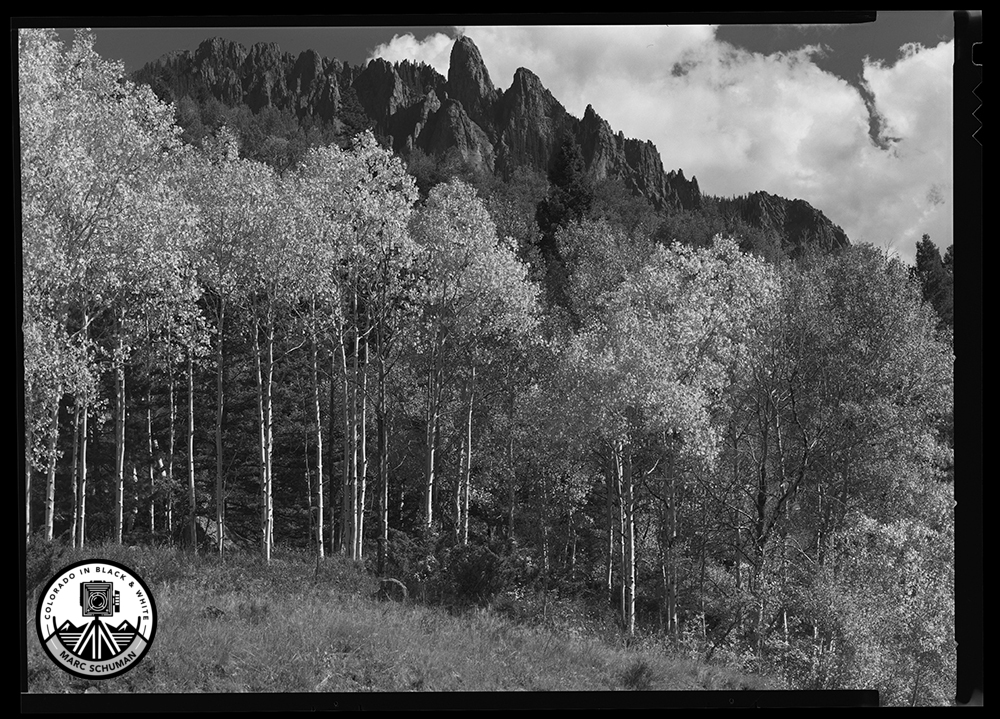
A Colorado mountain photograph earns its place on a wall when it offers more than a recognizable summit. The strongest Colorado mountain wall art carries the weight of weather, altitude, geology, and light. It gives a room a genuine sense of place without relying on color or decoration to make its point.
Black-and-white photography is especially suited to this country. In the mountains, light moves quickly across snowfields, timber, stone, and distant ridgelines. Removing color reveals the structure beneath the scene: the deep shadow of a canyon, the pale sweep of winter sky, the hard edge where a sunlit peak meets a gathering storm. The result can feel both immediate and enduring.
Why Black and White Belongs in Mountain Interiors
Colorado is often presented in saturated blue skies and bright alpine color. That approach can be beautiful, but it is not the only way to understand the landscape. Monochrome asks the eye to linger over form, texture, and scale. A stand of aspens becomes a study in line; a snow-covered range becomes an arrangement of luminous planes and dark recesses.
For a home, office, hotel, or public space, this restraint has practical value as well. A black-and-white mountain print can work comfortably beside warm wood, stone, steel, contemporary furnishings, or older architectural details. It brings visual presence without competing with every color already in the room. The image does not need to match the furniture. It needs to hold attention.
That distinction matters. Generic mountain decor may fill a large blank wall, but an original photograph can establish a lasting focal point. The viewer returns to it because the image continues to reveal different relationships between light and land.
Colorado Mountain Wall Art Begins With the Negative
The character of a finished print is established long before it is framed. Many mountain subjects are photographed with medium and large format cameras, chosen for their deliberate working method and exceptional ability to describe fine detail and tonal transition. These cameras are not built for hurried picture-making. They require careful placement, measured focus, considered exposure, and patience with changing conditions.
A large negative records subtle information in the rock, snow, cloud, and forest that can be lost in smaller formats. It also gives the printmaker greater control when interpreting the image in the darkroom. That matters in a landscape where the difference between a convincing sky and a flat one may be found in the smallest gradation of gray.
Working with medium and large format equipment also changes how a photographer sees. Setting up a camera on a tripod encourages a measured response to the landscape. Rather than collecting views, the photographer studies the direction of light, the movement of cloud, the balance of foreground and distance, and the moment when the scene becomes coherent. The photograph is composed, not merely captured.
The Print Is the Work
A digital file can be reproduced almost without limit. A fine-art photographic print is something else entirely. In a traditional silver halide fiber-base print, the image emerges through an exposure onto photographic paper and a sequence of chemical development, washing, and finishing. Each stage affects the final presence of the photograph.
The goal is not simply a dark print with bright highlights. It is tonal richness: detail held in shadow, separation in the midtones, and highlights that feel luminous rather than empty. Fiber-base paper adds a physical depth and surface character that suits black-and-white mountain imagery. It rewards close viewing while retaining authority from across a room.
Some images may also be produced as carefully selected inkjet prints, where the paper and ink are chosen to serve the photograph rather than imitate a mass-market poster. The appropriate process depends on the image, the desired scale, and the qualities a collector values most. What should remain constant is the artist’s attention to the finished object.
Choosing the Right Mountain Photograph for a Room
The best choice depends partly on the wall and partly on the feeling a space needs. A broad panoramic vista can establish calm above a fireplace, behind a reception desk, or along a long hallway. A more intimate study of a ridge, snowbound trees, or weather moving through a pass can be stronger in a library, bedroom, or quiet office.
Scale deserves real consideration. A small print can be compelling when viewed closely and given room to breathe. On a large wall, however, it may lose the visual force that made the photograph appealing. Larger prints allow mountain forms and tonal detail to read at a distance, particularly in open rooms with high ceilings. The trade-off is that a large image needs adequate viewing space. A dramatic print placed too close to seating may be difficult to experience as a whole.
Framing should support the photograph rather than announce itself first. Simple black, dark wood, or restrained natural finishes often work well with monochrome Colorado scenes. Matting can provide a useful visual margin, especially for smaller prints, while a larger framed work may benefit from a more direct presentation. The room’s light also matters. Avoid placement where persistent glare obscures the print, and consider how daylight will change the image over the course of a day.
A Sense of Colorado That Does Not Fade
Mountain photography has lasting appeal because it records conditions that are both specific and universal. A particular peak, valley, or high-country storm may be unmistakably Colorado, yet the photograph can also suggest solitude, endurance, and the passing of time. These are qualities that do not depend on a design trend.
For collectors, this is where original work separates itself from decorative imagery. The value is not only in the subject. It lies in the photographer’s decisions: where to stand, when to expose the film, what to include, what to leave out, and how to bring the negative to life in print. Those decisions create an image with a point of view.
Colorado mountain wall art should feel at home with the rest of a room, but it should never become invisible. Choose a photograph whose light, scale, and mood invite a second look. Over years of living with it, that quiet demand for attention is often the mark of a print worth keeping.