
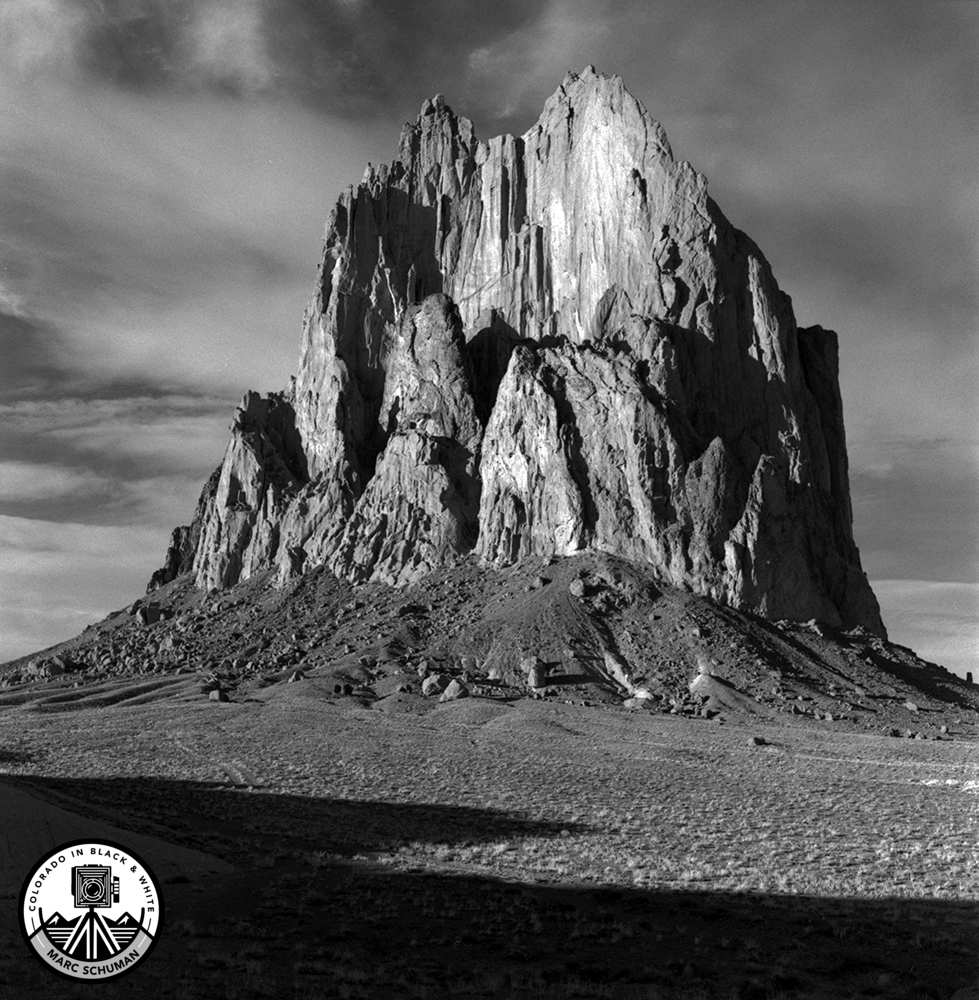
Fine Art Black and White Photography at COLORADOINBLACKANDWHITE.COM.
A western landscape is rarely quiet. Wind works across the grasslands. Weather changes the face of a mountain in minutes. A railroad grade, an abandoned homestead, or a line of cottonwoods can hold as much history as a dramatic summit. Western landscape photography art earns its place on a wall when it recognizes that complexity and gives the viewer room to stay with it.
Black and white is particularly suited to this country. Without the immediate pull of color, attention moves to form, distance, weather, and light. Rock strata become graphic. Snowfields become luminous. A dark stand of pines can establish scale against a broad, open sky. The result is not a record of a scenic stop, but an interpretation of place.
Why the West Belongs in Black and White
The American West is often photographed for spectacle. Grand color at sunrise has its power, but it can also make every location look familiar. Monochrome asks a different question: what remains when color is removed?
The answer is structure. In black and white, the eye follows a ridge line, the repeating rhythm of fence posts, or the way clouds gather over a valley. Tonal relationships carry the image. A pale road crossing dark earth may become the central gesture of the composition. Fog can reduce a landscape to a few essential planes, making a known place feel newly discovered.
This restraint is not a limitation. It is a discipline. Successful monochrome photographs require the artist to see how colors will translate before the shutter is released. Green, red, and blue may appear similar in a straight black-and-white conversion, yet each can be separated through film choice, filtration, exposure, and printing. The final print is built through a sequence of decisions, not produced by pressing a button.
The Deliberate Pace of Larger Cameras
Much of the character in fine-art western landscape photography comes from the way the work is made. Medium-format and large-format cameras slow the process down. They demand a tripod, careful composition, measured exposure, and an honest consideration of whether the light has truly arrived.
A medium-format negative provides substantial detail and smooth tonal transitions. It is well suited to subjects where texture matters: weathered wood, distant forests, sandstone, railroad equipment, and the subtle grain of high-country terrain. Large-format equipment goes further still. The broad negative records remarkable information, while camera movements allow the photographer to control focus and perspective with precision.
Those movements matter in the field. Tilting or swinging the lens and film plane can hold foreground and distance in focus without relying on a small aperture alone. Rise and fall can correct the visual distortion of tall subjects, whether a cliff face, old structure, or stand of trees. These are not technical tricks. They are tools for making the print reflect the photographer’s experience of standing before the scene.
The trade-off is speed. A small camera can respond to a passing instant. A large-format camera is better for the patient encounter: a clearing storm, low winter light, water receding from a shoreline, or the final arrangement of clouds over a peak. Neither method is inherently superior. The subject and the intended print determine the right instrument.
From Negative to Finished Print
A negative is not the finished work. It is the beginning of the printmaking process.
For traditional silver halide fiber-base prints, the negative is placed in the enlarger and interpreted under darkroom light. Exposure establishes the overall character of the image, but dodging and burning refine it. A little more light may give weight to a sky. A carefully held-back area may preserve detail in snow or bring an old rail line forward from the shadows. Each choice must serve the composition rather than call attention to itself.
Fiber-base paper has a physical presence that is difficult to imitate. Its surface, depth, and tonal response reward close viewing. Rich blacks can coexist with delicate highlight detail, while the middle tones carry much of the atmosphere. This is especially important in western subjects, where the difference between a flat gray print and a convincing one may be found in the subtle transitions across distant hills or storm clouds.
Selected images may also be produced as fine inkjet prints, particularly when the image and available paper are best served by that process. A fine-art print should not be judged solely by the method used, however. It should be judged by clarity of vision, tonal control, permanence, and the care given to the finished object. Mass-produced decor is designed for quick replacement. An individually produced print is made to continue revealing itself over years of viewing.
Choosing Western Landscape Photography Art for a Room
A strong photograph does not need to match every color in a room. Black-and-white work often succeeds because it creates visual order without competing with furnishings, textiles, or architectural finishes. It can bring calm to a contemporary interior or add gravity to a more traditional setting.
Scale deserves careful thought. A small print can feel intimate, inviting close observation of a lone tree, a railroad curve, or the texture of a weathered building. A larger print can establish a room, especially when the photograph contains a broad horizon or an expansive sky. The image should have enough visual information to reward its size. Not every negative wants to become a large print, and restraint is part of good presentation.
Consider the emotional temperature of the subject as well. A snow-covered mountain scene may bring clarity and stillness to a private office. A dramatic cloudscape can give a hospitality space a sense of movement. Historical western imagery, railroads, and working landscapes often suit rooms that benefit from a connection to heritage and human endeavor.
Placement affects the experience. Avoid putting a print where direct sun will strike it for long periods, and give it enough surrounding wall space to breathe. Proper framing should support rather than overpower the photograph. Simple, well-made materials allow the tones of the print to remain the focus.
A Photograph With a Sense of Place
The finest western landscape photographs do more than identify a location. They preserve a particular encounter with terrain, season, and light. A print of Colorado or the wider West can recall a journey, but it can also create a relationship with a place the viewer has never visited.
That is the lasting value of patient photographic work. Film, larger cameras, careful negatives, and hand-finished prints all serve the same purpose: to make an image that feels considered rather than merely captured. Choose the photograph that continues to hold your attention after the first glance. That is often the one that will belong in your space for a long time.
#newmexicoblackandwhitelandscapes
#silverhalidelandscapephotography
#gelatinfineartprints